terça-feira, 28 de maio de 2019

How the 'Change Generation' Is Motivating Businesses to Commit to Sustainability

  • Photo: Hero Images | Getty Images
  • Photo: Hero Images | Getty Images

    Image 1 of 1

    Photo: Hero Images | Getty Images

    How the 'Change Generation' Is Motivating Businesses to Commit to Sustainability

    1  /  1

    Back to Gallery

    As climate change intensifies, what's under-recognized in the global debate is that one of the most powerful antidotes to the escalating destruction is also one of the simplest and most affordable: trees.

    Trees absorb more than two billion tons of carbon globally every year -- equivalent to one third of annual fossil fuel emissions, while cleaning our air and protecting our precious drinking water. Just one acre of hardwood trees can offset the entire carbon footprint of 18 people. Each tree we plant is a stalwart protector of our planet, but leading experts warn we're not planting enough trees to mitigate the impact of a changing climate.

    Between 1990 when scientists from around the world gathered for the World Climate Conference in Geneva and 2017, carbon emissions increased 163 percent. During this same period, diplomats crisscrossed the globe again and again, negotiating the Kyoto Protocol, the Rio de Janeiro Earth Summit and the Paris Climate Accord. Yet carbon emissions have continued to skyrocket.

    Related: It's Official: Customers Prefer Sustainable Companies

    Billions have also been invested in renewable energies to replace fossil fuels. These non-carbon energy sources show great promise, but after decades of concerted effort, renewable energies – like wind and solar power – account for only 20 percent of total energy consumption worldwide.

    These solutions alone have not been successful.

    A future that's coming into sharp focus -- of a planet with unbreathable air, polluted water, and devastated parks and forests -- is landing most powerfully with young professionals. People under age 30 identify "climate change and the destruction of nature" as the world's most urgent problem, ahead of war and inequality, according to global surveys by the World Economic Forum in 2017 in 186 countries.

    Related: Amazon Employees Call for a Company-Wide Climate Change Plan

    Dubbed the Change Generation, Gen Z and younger millennials are taking over the global workforce. Increasingly, they seek employment with socially responsible companies committed to a greater purpose. Nearly 90 percent of millennials would consider taking a pay cut to work at a company whose mission and values align with their own, according to LinkedIn's 2018 Workplace Culture Trends report. Further, 89 percent expect employers to provide hands-on activities around environmental responsibilities in the workplace.

    Will a global movement from these activist employees who comprise nearly 30 percent of the workforce compel businesses to find real solutions for climate change? Will the competition for talent drive more and more companies to take a hard look at what they can do to attract and retain these eco-focused workers?

    If so, tree planting and what it represents is a corporate social responsibility (CSR) pathway that any business can adopt and scale to create authentic employee engagement opportunities. You don't need to be a multinational corporation to do it; even a single tree can have impact, absorbing as much as 48 pounds of carbon dioxide every year. A 10-employee start-up can participate and contribute easily and cost-effectively.

    A global awakening to the urgent need to plant more trees is already underway. Reforestation of historic proportion is transforming the landscape in many countries, notably in China, India and most recently Australia, which earlier this year committed to a massive tree planting program that will continue for decades.

    Related: The Far-Reaching Impact of Embedding a Sustainable Workplace Culture for World Earth Day -- Today!

    The Arbor Day Foundation is proud to be part of this broad global crusade. Our new Time for Trees™ initiative pledges us and our corporate partners to plant 100 million trees worldwide by the year 2022. The companies that have joined us range from small businesses on the cusp of expansion to global brands with deep sustainability roots; all are connected by a common passion to preserve our planet.

    Companies that commit to sustainability efforts like tree planting enjoy not only increased brand loyalty – and in turn, increased sales, but a more committed, engaged workforce that recognizes their employer shares their values and reflects a greater vision for a healthier planet.

    Together we can address the most critical challenge we all face, provide powerful experiences for employees and plant a better future for all of us, one tree at a time.

    Related:How the 'Change Generation' Is Motivating Businesses to Commit to SustainabilityThis Digital Startup is Re-defining the 'Impact' of Corporates' Social ResponsibilityHow Tech Platforms are Helping CSR in India

    Copyright 2019 Entrepreneur.com Inc., All rights reserved

    This article originally appeared on entrepreneur.com

    segunda-feira, 20 de maio de 2019

    Here's How to Successfully Grow Your Own Avocado Tree

    a bowl of fruit on a plate: Here's How to Successfully Grow Your Own Avocado Tree © Pexels / Anne Here's How to Successfully Grow Your Own Avocado Tree

    With the price of avocados on the rise, many people are becoming increasingly interested in growing their own. But how exactly do you do it? And, more importantly, do you live in a place where it's even possible? Avocados have been growing very well in the south central part of Mexico for centuries due to the ideal hot climate. And in the United States, California, Florida, Hawaii, and southern Texas all have similar climates. If you live in one of these states, you're in luck, but if you don't, the chances of growing an avocado tree are unfortunately slim to none.

    If you do reside in a warmer spot and are ready to try growing your own, here's what you need to know to ensure your avocado tree grows well:

    Determine which variety you want to grow. There are about 500 varieties of avocados. Hass avocados are the most popular because of their great taste and richness.

    Purchase your avocado tree. It's best to purchase your avocado seedling from a garden center or nursery.

    Determine when and where you'll plant your avocado tree. It's best to plant your tree in the springtime between the months of March and June and in a spot where it will get the most sunlight. Make sure it's not near other trees, your home, or any power lines, because avocado trees don't do well when they're crowded.

    Plant your avocado tree. Dig a hole that's three to four times the diameter of the container your seedling came in, and make sure the soil is level with or a little above the top of the rootball.

    Add mulch and water. Immediately after you plant your avocado tree, add a thick layer of coarse mulch, and give it a deep watering. During the first week, you should water your tree every other day. After that, you should water it once or twice a week. (Tip: let the tree's leaves accumulate under the tree to act as added mulch. The leaves will keep the ground moist and help conserve water.)

    Fertilize Your Avocado Tree. It's important to make sure your young avocado tree is well nourished with nitrogen, phosphorous, potassium, and zinc in order to keep it growing and developing. During your tree's first year, you should fertilize it three times total - once in the Spring, once in the Summer, and once in the Fall. As your tree matures, it will require different nutritional needs, so be sure to check out Gardening Know How for more advice and tips.

    sábado, 18 de maio de 2019

    Is this plant poisonous? How often to water big evergreen trees? Ask an expert

    Spring has sprung and gardeners are digging in. Got questions as you carry on? Get answers from Ask an Expert, an online question-and-answer tool from Oregon State University's Extension Service. OSU Extension faculty and Master Gardeners reply to queries within two business days. To ask a question, simply go to the OSU Extension website and type in a question and the county where you live. Here are some questions asked by other gardeners. What's yours?

    Is this plant poisonous? Looks like poison hemlock.

    Looks like poison hemlock.

    Q: Is this a poisonous plant? Last year I had one similar and it grew 10 feet tall. Now these plants are all over a perennial garden. If it's poison how do I get rid of it?

    – Clackamas County

    A: It appears to be poison hemlock. Here is more information to help you control it.

    – Kris LaMar, OSU Extension Master Gardener

    How to stabilize greenhouse temperatures? Circulation is key to regulating greenhouse temperatures.

    Circulation is key to regulating greenhouse temperatures.

    Q: My husband and I just built a greenhouse from recycled windows. We were wondering if there are best recommendations for stabilizing the temperatures inside the greenhouse? It is getting pretty toasty in there during the day, so we are going to put up a shade cloth of some kind, but is there a shade cloth that also works somewhat as an insulator overnight to help prevent temperature drops? We do have a brick floor and some water jugs to help with keep everything a little warmer at night.

    – Deschutes County

    A: The appropriate amount of ventilation (at least 25% the size of the total square footage of the floor) is the best way to cool a greenhouse. Roof ventilation is ideal, but doors and windows can be used also so air can pass through. Are you leaving the door open? Shade cloth will only cool a little and is not a substitution for ventilation. Also shade cloth affects plant growth, so it should be used with crops that can handle decreased light. The ideal temperature range for plants is 50 to 85 degrees. Shade cloth is not typically used for insulation, just to adjust the light emission.

    – Amy Jo Detweiler, OSU Extension horticulturist

    How often to water established evergreens? How often should you water fully established trees?

    LC-

    How often should you water fully established trees?

    Q: I have three large redwoods and numerous cypress and other evergreens. We'd like to spread a 3-inch layer of well-aged compost under them to cover the needles that were dropped. Will this help build up the nutrients in the soil and help reduce the combustible material in the event of a wild fire? Also, last year due to the many months of sun many of the trees were stressed. We will be watering this year. How often should we water large fully established trees?

    – Clackamas County

    A: First, pine needles decompose very slowly, so covering them up with compost will create a mat of needles under the compost, and the benefits of nutrients from the compost will be reduced. And you'll find still-decomposing needles years from now. This Extension article recommends no more than 10% of compost be needles. Needles dry out quickly, so I'd recommend you rake out most of them before applying compost.

    Second, the fire danger will not be mitigated by adding composted material, which will eventually dry out, too. I don't know how close the trees are to your house, but here are some tips for wildfire danger control. Finally, as to watering mature trees. I suggest you invest in a water moisture meter, which you can use in any garden, so you can see how dry the soil is. Although these trees' roots are often deep, we are seeing many established trees suffering water stress in our summers. It is more effective to water less often, but thoroughly for several hours, rather than often and shallowly. But the probe can tell you how far down the water has penetrated. Every two weeks should be enough.

    -- Kris LaMar, OSU Extension master gardener

    MORE ADVICE FROM THE EXPERTS

    Subscribe to newsletters from The Oregonian/OregonLive, including Homes & Gardens emailed to you every Friday.

    quinta-feira, 16 de maio de 2019

    The most effective way to tackle climate change? Plant 1 trillion trees

    Tom Crowther is a climate change ecologist at Swiss university ETH Zurich. Four years ago he found there are about 3 trillion trees already on earth -- much higher than NASA's previous estimate of 400 billion. Now, his team of researchers has calculated there is enough room on the planet for an additional 1.2 trillion -- and that planting them would have huge benefits in terms of absorbing atmospheric carbon dioxide, the main driver of climate change.

    "The amount of carbon that we can restore if we plant 1.2 trillion trees, or at least allow those trees to grow, would be way higher than the next best climate change solution," Crowther told CNN.

    Because his research is currently under review for publication in the journal Science, he says he can't share exact figures of how much extra CO2 could be stored by those trees. But he points to numbers from Project Drawdown -- a non-profit that ranks climate solutions by the amount of CO2 they could remove from the atmosphere. Its number one ranked solution -- managing the release of HFC greenhouse gases from fridges and air conditioners -- could reduce atmospheric CO2 by 90 billion tons. Crowther says planting 1.2 trillion trees would give a reduction "way above" that figure.To put that in context, global CO2 emissions are around 37 billion tons per year.

    Can it be done?

    But while there may be space for a trillion new trees, is it actually practical to plant that number?

    One organization that thinks so is youth-led Plant for the Planet (PFTP), which is running the "Trillion Tree" campaign to do just that.

    Set up as the "Billion Tree" campaign by the UN in 2006, it was later handed over to PFTP, which has upped its planting ambitions in response to Crowther's work.

    Felix Finkbeiner founded Plant for the Planet in 2007, when he was just nine years old. He is now a PhD student at Tom Crowther's lab at ETH Zurich. He's pictured at an award ceremony in 2015.

    Felix Finkbeiner founded Plant for the Planet in 2007, when he was just nine years old. He is now a PhD student at Tom Crowther's lab at ETH Zurich. He's pictured at an award ceremony in 2015.

    Felix Finkbeiner founded Plant for the Planet in 2007, when he was just nine years old. He is now a PhD student at Tom Crowther's lab at ETH Zurich. He's pictured at an award ceremony in 2015.

    It has already planted nearly 15 billion trees, with the help of various governments, including India's, which has planted more than 2 billion trees as part of the initiative.

    "I think a trillion trees is achievable," says PFTP chairman Sagar Aryal. "It's not that we don't have enough money in the world -- maybe governments alone can't do enough but if we work together with the private sector we can do it."

    The right location

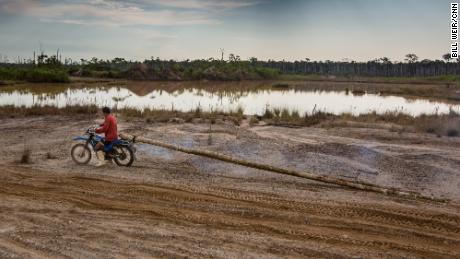
    Crowther is a scientific adviser to Plant for the Planet, providing them with information on the best places to restore trees. He says all the locations identified by his team are on degraded land, rather than agricultural or urban areas.

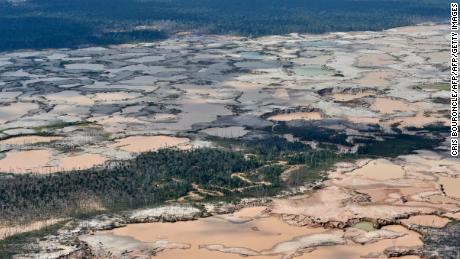
    Record levels of gold mining are destroying one of the most biodiverse places on Earth, study shows

    Record levels of gold mining are destroying one of the most biodiverse places on Earth, study shows

    "These are places where farms have been abandoned, or where there's been deforestation and it's been left," he explains.

    To successfully fight climate change, it's vital that the right land is restored. For example, in parts of northern Europe, planting more trees could reduce the heat and light reflected from snowy ground, and actually increase global warming.

    A chemically deforested area of the Amazon caused by illegal mining in southeast Peru, February 2019.

    A chemically deforested area of the Amazon caused by illegal mining in southeast Peru, February 2019.

    A chemically deforested area of the Amazon caused by illegal mining in southeast Peru, February 2019.

    Joseph Veldman, of the department of ecosystem science and management at Texas A&M University, told CNN that although reforestation can play a role in carbon sequestration, "There is no doubt that super-aggressive tree planting efforts that are not done with consideration of the historic ecosystem will be a bad investment."

    Global climate targets will be missed as deforestation rises, study says

    Global climate targets will be missed as deforestation rises, study says

    He says some previous reforestation projects have targeted grasslands and savannah ecosystems that already play an important role in storing carbon.

    Such schemes often plant exotic trees, like pine and eucalyptus, which are very flammable and also valuable as timber and pulp, he says. As a result, the carbon they store above ground can be lost to wildfires or logging.

    Crowther agrees wholeheartedly. "All the models that previously existed about where forest can be restored disregard whether they should," he said. "We don't just model the forest, we also model grasslands and shrublands and piece them all together to reveal what should be where."

    Growing in popularity

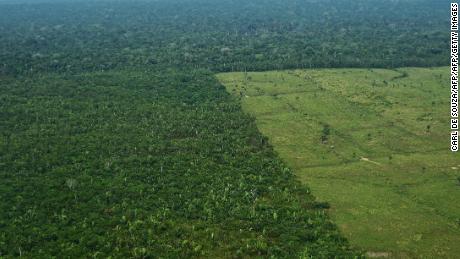
    Tree planting is no quick climate fix. It can take 30 to 40 years of growth for the carbon storage to reach its full potential. A more immediate benefit can come from halting deforestation, says Crowther, which costs our planet around 15 billion trees each year.

    Why Brazil's Jair Bolsonaro has environmentalists worried for the Amazon

    Why Brazil's Jair Bolsonaro has environmentalists worried for the Amazon

    But although tree planting on such a colossal scale faces significant challenges (not least identifying who owns the land in question, and securing the rights to plant and maintain trees there), widespread efforts are already underway.

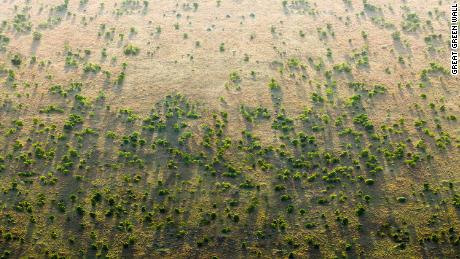
    The Australian government has announced it will plant 1 billion trees by 2030; work is underway on a "Great Green Wall" to stop the spread of the Sahara by restoring 100 million hectares of degraded land (and sequester 250 million tons of carbon), and China's anti-desertification program, also known as the "Great Green Wall," has planted more than 50 billion trees since the 1970s. The UN-endorsed Bonn Challenge aims to reforest 350 million hectares of degraded land globally by 2030. Africa's Great Green Wall aims to slow down desertification.

    Africa's Great Green Wall aims to slow down desertification.

    Africa's Great Green Wall aims to slow down desertification.

    Crowther says he was once skeptical about the benefits of tree planting, but has now changed his mind.

    "Climate change is seen as such an immense and complicated issue -- it feels like it's seen as someone else's problem, someone else is dealing with it or not dealing with it, and no one has a simple message for how to go about tackling it," he says.

    "I'd like to try and champion this as a solution that everyone can get involved in. If all the millions of people who went on climate marches in recent weeks got involved in tree planting the impact would be huge."

    Eric Bergeson. "The Next Three Weeks is an Essential Time to Plant Trees."

    Techniques for plants trees in round pots, newly potted and bare root.

    In This Podcast:  Eric Bergeson, author of "Successful Gardening on the Northern Prairie."

    Topics:  

    Now is the prime time for planting trees on the Northern Prairie.  Eric gives tips on how to plant trees depending upon how you acquire them.  

    For instance if you're planting  "Root-Bound in Pots," in which you break the root bag apart before planting.  (Listen for details.)

    If you're planting "Newly-Potted Trees," you should treat them tenderly.

    Finally, "Bare-Root" trees have the best chance for survival.

    I also asked Eric about whether "peat" was  in danger of being all used up.  Hint:  "No."  (Something less for me to worry about.)

    (Jack Sunday is a radio veteran with 50-years "behind the mike." He likes to say he's not old...just aging. Follow him on Facebook and Twitter @nodakjack. Listen weekdays, 4-6pm on KFGO.)

    Last Updated By: Jack Sunday on Thursday, May 02, 2019 6 p.m.

    quarta-feira, 15 de maio de 2019

    How to tackle the most common issues for crape myrtle trees the organic way

    Crape myrtle trees are not native to Texas or anywhere else in the U.S., but they are great ornamental tree choices. Behaving themselves for the most part, they provide long-lasting summer color and usually quite pleasant fall color. They do have some problems, but those can be easily solved with natural organic techniques.

    The most common issue is pruning. The mistaken notion should be put to bed by now, but many in the landscape maintenance business and some homeowners still think it's good to severely "top" crape myrtles in winter. It shouldn't be done. Nothing good comes from it. Heavy pruning, especially slashing the tops off, leads to weaker growth and flowering as well as stress, thus more insect pests and diseases. If the tree is too large for the spot where it's planted, cut the tree down and plant an appropriately sized plant.

    Crape myrtle trees can get powdery mildew on their leaves.(Howard Garrett)

    Crape myrtle trees can get powdery mildew on their leaves.

    (Howard Garrett)

    Mildew and pests

    Powdery mildew is the next most common issue. It is a fungal disease resulting from susceptible varieties and stress related to environmental pressures. Being careful to purchase disease-resistant varieties and cultivars certainly helps when you have that option. And mildew can be cured temporarily with organic disease sprays such as cornmeal juice, baking soda or potassium bicarbonate in water, or commercial products such as PureGro Disease Control. 

    Black sooty mold caused by aphid waste can also be temporarily controlled with the same products. Aphids and other insect pests can be killed with any of the essential oil organic sprays.

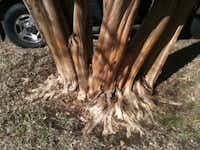
    This crape myrtle tree has a properly exposed trunk flare.(Howar   d Garrett)

    This crape myrtle tree has a properly exposed trunk flare.

    (Howard Garrett)

    De-stress your trees

    A more permanent solution to disease and pest problems (including the dreaded white scale) results from applying the Sick Tree Treatment. It is not a product, but rather a procedure that starts with the proper and dramatic removal of plants, mulch and soil from the bases of trees. 

    Trees planted too deep in the ground is without question the most common environmental cause of plant stress, pests and parasites. A flare being covered by anything is unnatural and unhealthy. Root flares/trunk flares are part of the trunks and if exposed to air are able to properly breathe. 

    When covered by ground covers and vines or any kind of soil or mulch — including gravel or stones — the bark cannot breathe properly, stress sets in, and the pest problems result.

    Crape myrt   le trees showing off their potential with vibrant blooms.(Howard Garrett)

    Crape myrtle trees showing off their potential with vibrant blooms.

    (Howard Garrett)

    Resources

    Online: dirtdoctor.com or facebook.com/thedirtdoctor.

    Radio: "The Answer" KSKY-AM (660), 8 to 11 a.m. Sundays. ksky.com. The call-in number is 1-866-444-3478.

    Mail: P.O. Box 140650, Dallas, TX, 75214

    domingo, 12 de maio de 2019

    How to Plant Desert Willow Tree Seeds

    Start seeds in flats and grow them in containers through the first winter.

    Start seeds in flats and grow them in containers through the first winter.

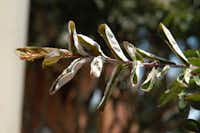
    Native to the southwestern regions of the United States and Mexico, desert willow (Chilopsis linearis) is a low-maintenance shrub that grows well in dry conditions in U.S. Department of Agriculture hardiness zones 7 through 9. Although its name indicates otherwise, this 10- to 15-foot shrub is not a true willow; rather, it belongs to the trumpet-creeper (Campsis radicans) family and it was named for its willow-like foliage. It blooms with large, trumpet-shaped flowers from the beginning of summer through the first frost and it is easily grown from seed.

    Seeds

    By early autumn, desert willow's slim seedpods replace the plant's flowers. The pods average 6 to 10 inches long, and once they turn dry and brown, you can easily crack them to reveal the feathery seeds within. The plant most successfully grows from fresh seeds, according to the Native Plant Society of Texas, although they can also grow successfully from seeds previously stored in a cool location, in sand or between pieces of wet blotter paper.

    Growing Conditions

    Choose a planting location with full sun exposure and well-drained soil. According to the website for the Lady Bird Johnson Wildflower Center, desert willow prefers limestone soil, but also grows well in rocky, caliches, loam, sandy and granitic soil, with minimal need for you to add any organic matter to the soil. This low-water plant tolerates dry conditions and has a high drought tolerance. Allowing it to dry out between watering it helps encourage continual blooming.

    Sowing

    Although it may be possible to sow the seeds directly into the soil in the garden, Plants for a Future recommends sowing the seeds in flats or nursery pots in spring. Sow the seeds about 1/4 inch deep in moist potting soil. Once the seedlings have at least two sets of leaves and are large enough to handle, transplant them into individual pots filled with potting soil. Horizon Herbs, plant growers, recommend growing desert willow in pots for a year before transplanting them outdoors.

    Transplanting Desert Willow

    Gradually harden off the young desert willow tree by placing it in a sheltered spot outside, giving it about two to three hours of sunlight before bringing it back inside for the night. Spend seven to 10 days gradually increasing the plant's sun exposure by an hour or so every day to help the young plant become acclimated to outdoor conditions. (Ref 6) Dig a hole that is twice as wide and equally deep as the plant's root ball, allowing the plant to be as deep as it is in its current container while giving the roots plenty of space to spread out. Remove the young desert willow from its container, loosen the roots on the outside of the root ball and place in the hole. Fill the hole with soil, avoiding putting any soil on top of the plant's root ball. Water the area thoroughly and cover with 3 to 4 inches of hardwood mulch. Space multiple desert willows about 10 to 15 feet apart.

    ]]> About the Author Caryn Anderson

    Caryn Anderson combines extensive behind-the-scenes writing experience with her passion for all things food, fashion, garden and travel. Bitten by the travel bug at the age of 15 after a trip to Europe, Anderson fostered her love of style and fashion while living in New York City and earning her degree at New York University.

    Photo Credits
  • Hemera Technologies/PhotoObjects.net/Getty Images
  • bibliography-iconicon for annotation tool Cite this Article Choose Citation Style MLA APA Chicago (B)

    Anderson, Caryn. "How to Plant Desert Willow Tree Seeds." Home Guides | SF Gate, http://homeguides.sfgate.com/plant-desert-willow-tree-seeds-75729.html. Accessed 11 May 2019.

    Anderson, Caryn. (n.d.). How to Plant Desert Willow Tree Seeds. Home Guides | SF Gate. Retrieved from http://homeguides.sfgate.com/plant-desert-willow-tree-seeds-75729.html

    Anderson, Caryn. "How to Plant Desert Willow Tree Seeds" accessed May 11, 2019. http://homeguides.sfgate.com/plant-desert-willow-tree-seeds-75729.html

    Copy Citation

    Note: Depending on which text editor you're pasting into, you might have to add the italics to the site name.

    quinta-feira, 9 de maio de 2019

    'The best defense is consistency:' Here's how to deal with that pesky Kudzu plant

    JONES COUNTY, Ga. — Ginger Hudson has overcome a lot of battles. She lost her first husband and survived breast cancer, but now she's at war with Kudzu.

    "10 years ago we had it under control. I don't even know the name of the stuff my husband used. He got it from a place that's no longer in business in Macon," Hudson said.

    It's actually quite pretty to look at, which is what owner of U.S. Lawns in Macon-Bibb Greg Israel says made it useful.

    "Kudzu was introduced intentionally to America, imported from Japan. In the 1930s, it was considered a ground cover and used for erosion control," he said.

    Don't let looks fool you, Kudzu is an invasive species that attacks everything in its path.

    RELATED: Is Macon's pollen count higher than usual?

    "It's choking everything out. It's covering them. You can't see anything. There was a tree underneath that big bush right there, but it's no longer there, because the Kudzu is killing it," Hudson said.

    Israel explains this further.

    "It grows more rapidly than anything else it can compete with, and it just chokes it out," Israel said.

    Israel says the plant spreads through its seeds and roots.

    "It just invades everywhere it's at. It hasn't been planted all over the Southeast, but through birds, through wind, it's moved across the southeast United States at a rapid pace," Israel said.

    He says Kudzu covers about seven million acres across the Southeast, since it thrives in the hot, humid climate, but how do you get rid of it?

    "The best defense is consistency. If you've got a stand and you're mowing it, you need to mow it consistently so it'll eventually, if it can't get sunlight, if it can't get nutrients, it eventually will die, but we're talking months and years of being consistent," he said.

    Israel says it takes 40-80 gallons of chemical treatments per acre to control it, which can get pricey since it grows about a foot a day.

    "The chemicals aren't the solution, the chemicals are just an assist, therefore when you go with Kudzu, trying to attack it with a chemical is not practical," he said.

    RELATED: VIDEO: Massive pollen cloud rises from fallen tree

    Israel advises against pulling it by the roots, which Hudson can't anyway since she's allergic to it, but she's just looking for anyone to help.

    "You got way too many to pull up by the roots. I don't want to set fire to it, because I hear that doesn't work. I don't want to use Roundup cause I don't want to kill everything around it, so I just need to know what to use," she said.

    Israel says some reports suggested using goats or cattle to graze on Kudzu to help control it, but the best way to fight it is to keep a well-maintained yard.

    quarta-feira, 8 de maio de 2019

    UAB is planting an environmentally conscious future. Learn how the campus’s more than 4,000 trees are improving Birmingham

    Sponsored

    UAB staff planting tree during 2019 Arbor Day celebration. Photo courtesy of UAB Sustainability

    This Spring, visit the Vulcan Park and Museum. Purchase a ticket to take the elevator to the top of Vulcan's pedestal. Look north toward the Birmingham skyline. Below you and to the west is the UAB campus, spread out over 100 blocks on Birmingham's Southside.

    From your perch at Vulcan, you see the buildings that house research facilities and a world-class hospital. It is also the workplace of faculty and staff and home to many students.

    Nestled among UAB's buildings and open spaces there is a lush forest with over 4,400 trees covering the campus like a green blanket.

    UAB's trees are one of the university's greatest natural resources. Here is why.

    The Plan, Numbers and Value

    Group photo of UAB football player along with faculty and staff after planting trees commemorating UAB's 50th Anniversary. Photo courtesy of UAB Sustainability

    This past winter, UAB launched a new sustainability strategic plan that will transform the university's academic and medical campus by the year 2025.

    Preserving and increasing the number of trees on campus is a major priority in the plan.

    As an urban institution, UAB plans to invest significantly – greening the campus – through space allocation, communication, landscape and public realm design standards. And these kind of ventures are paying off.

    A couple of years ago, UAB Sustainability intern Nina Morgan inventoried all 4,400 trees on campus, with roughly 900 of those trees planted in the past five years. Her study was used to calculate the value of the trees throughout the campus.

    According to UAB Sustainability, since the university's start 50 years ago, its trees have provided an estimated $125 million worth of air pollution control, $126 million in soil erosion control and recycled at least $152 million worth of water.

    In 50 years, a single tree can generate up to $100,000 in controlling air and soil pollution in addition to conserving water in ecosystem services.

    Trees are not just of monetary value. UAB researchers have found that spending 20 minutes in an urban park simply makes people happier.

    Tree Campus USA

    Group photo of UAB staff, students and faculty after the 2019 Arbor Day celebration. Photo courtesy of UAB Sustainability

    One way UAB maintains stewardship of their forest canopy is meeting the standards set forth by the National Arbor Day Foundation to become a Tree Campus USA. UAB has received this recognition for 5 straight years.

    "It's exciting to see UAB making such a commitment to prioritizing green spaces on our campus and ensuring we have a healthy, happy tree population in the midst of our urban location," said Julie Price, PhD., manager of UAB Sustainability.

    To become a Tree Campus USA, the university must meet the following criteria:

  • Establish a tree advisory committee
  • Develop a campus tree-care plan
  • Dedicate annual expenditures for its campus tree program
  • Host an Arbor Day observance
  • Sponsor environmentally-related student service-learning projects
  • Heritage Trees – Live Oak and the Hippocratic Tree

    UAB's live oak at the Mini-Park. Photo by Pat Byington for Bham Now

    In the midst of UAB's 4,400 trees there are a few special ones that are cherished on campus.

    Live Oak at the Mini-Park

    Perhaps the most popular trees on campus are the live oaks on the UAB Mini Park at university Boulevard and 14th Street South, across from Heritage Hall. Providing shade for the statues of UAB founders and presidents Dr. Joe Volker and Dr. Scotty McCallum, these beautiful and grand live oaks are hundreds of miles north from their traditional geographical range.

    Hippocrates Tree

    Located in the 15th Street Greenway east of the Hill Student Center, the Platanus orientalis (Hippocrates tree) is a descendant of the tree under which Hippocrates. Photo by Pat Byington for Bham Now

    Located in the 15th Street Greenway east of the Hill Student Center, the Platanus orientalis (Hippocrates tree) is a descendant of the tree under which Hippocrates, often called the father of Western medicine, taught students of medicine on the Greek island of Kos around 400 B.C.

    This rare tree was donated by an anonymous donor and planted in 2016 in honor of the late William Brown Deal, M.D., dean emeritus of the School of Medicine.

    Preserving Trees

    UAB's enrollment is growing. Many new buildings are being constructed throughout campus including dorms and new classrooms. The growth poses a serious challenge for UAB Facilities project managers.

    They have proactively confronted arising issues by:

  • Maintaining a net-zero loss of trees policy on campus through the Tree Evaluation, Preservation and Mitigation Procedure.
  • Engaging all parties involved in construction about the value of trees on campus.
  • Protecting trees from the beginning of the construction process until the completion of the project.
  • Establishing procedures to ensure communication among all parties in setting forth expectations concerning tree protection.
  • A great example of these kinds of best practices set into motion is the preservation of the tree pictured above near the recently renovated School of Nursing.

    Planting for the Future – 50 trees for UAB's 50th Anniversary

    UAB football players planting trees on campus. Photo courtesy of UAB Sustainability

    In celebration of UAB's 50th Anniversary, the university will be planting 50 trees this year. The Facilities team is also continuously replacing fallen and damaged trees.

    One way you can give back to the university and the Birmingham community as a whole is by donating to the UAB Tree Fund.

    "At UAB, we recognize our tree canopy as vital public health infrastructure that reduces urban air temperatures, improves air quality, increases pedestrian comfort, reduces flooding, and improves well-being," said Price. "The trees we plant and care for now will benefit our community for generations to come."

    Be a part of the 50th Anniversary by donating a tree in the memory of a friend or loved one. That one gift will "give back" in so many ways – cleaner air, land, water and the general well-being and happiness of the community.

    Sponsored by

    Author: Pat Byington

    Longtime conservationist. Former Executive Director at the Alabama Environmental Council and Wild South. Publisher of the Bama Environmental News for more than 18 years. Career highlights include playing an active role in the creation of Alabama's Forever Wild program, Little River Canyon National Preserve, Dugger Mountain Wilderness, preservation of special places throughout the East through the Wilderness Society and the strengthening (making more stringent) the state of Alabama's cancer risk and mercury standards. View all posts by Pat Byington

    segunda-feira, 6 de maio de 2019

    City plants trees to offset doomed ash trees

    Published 2:37 pm CDT, Thursday, May 2, 2019

    BURLINGTON, Vt. (AP) — The city of Burlington, Vermont, is planting a variety of young trees to offset expected damage from an ash-tree killing pest.

    The Burlington Free Press reports that the emerald ash borer has already been detected in Colchester, Milton and South Hero and foresters estimate 150 million ash trees around the state are at risk.

    Last weekend, City Arborist V.J. Comai, other professionals, and volunteers planted about 60 trees among dominant stands of ash.

    Comai estimates that it would cost about $1.1 million to remove and replace the city's 1,249 ash trees.

    The beetle has killed hundreds of millions of ash trees in North America.

    ___

    Information from: The Burlington Free Press, http://www.burlingtonfreepress.com

    sábado, 4 de maio de 2019

    Discover the Importance of Oak Trees and How to Care for Them at 'An Evening for the Oaks' May 15

    Find out how planting an oak tree is one of the easiest, cheapest and best ways to help the environment at "An Evening for the OAKS" on Wednesday, May 15 from 6:30 to 7:30 p.m. at the Woodridge Park District Community Center, 2600 Center Dr. in Woodridge.

    Hosted by the Forest Preserve District of DuPage County and Woodridge Park District, this free program will include a brief presentation by local experts on planting and caring for oaks followed by a Q-and-A session. The program is for all ages, but attendees under 18 must be accompanied by an adult. Register online or at 630-933-7248.

    The first 50 people to register for the program will receive a free oak sapling. A limited number of oak trees will also be available for sale at the program.

    "Oaks are the foundation of our ecosystem," said Tom Velat, Forest Preserve District ecology coordinator. "They're dramatic and beautiful, but they also provide food and shelter for birds, insects and other wildlife year-round."

    "Oak trees are the reason the Woodridge Park District initiated restoration efforts at Hawthorne Hill Woods," said Christopher Pollack, Natural Resources manager for the Woodridge Park District. "Creating habitat that allows for new oak growth is vitally important to the ecological health of our community."

    Oaks can live to be 250 years old, but the county's population is aging. By planting saplings now, residents can ensure there will be mature oaks to replace them.

    Some interesting oak facts:

    ● Oaks are a keystone species. If they weren't around, other plants and animals might not be around either. Red-headed woodpeckers and flying squirrels depend on oaks' large cavities to raise their young. Over 500 insects live and feed on oaks, providing food for Wilson's warblers, American redstarts, common yellowthroats and other insect-eating migrants rely on oaks' "fast food" stops along the way.

    ● Oak trees are usually large in size. They can reach 70 feet in height and 9 feet in width. Their branches can reach 135 feet in length.

    ● Oaks produce more than 2,000 acorns a year, but only one acorn in 10,000 will grow into a tree. Deer, squirrels and other wildlife eat a lot of acorns, and acorns that don't end up as meals need special conditions to sprout. They must remain at certain temperatures for four to eight weeks. If the weather is too warm or too cold, the process cannot start.

    ● An oak tree can soak up 50 gallons of water in one day. This means oaks can play an important role in flood-control efforts.

    The Forest Preserve District of DuPage County has been connecting people to nature for more than 100 years. More than 4 million people visit its 60+ forest preserves, 145 miles of trails, six education centers and scores of programs each year. For information, call 630-933-7200 or visit dupageforest.org, where you can also link to the District's e-newsletter, blog, Facebook, Twitter and Instagram pages.

    Founded in 1969, the Woodridge Park District serves approximately 35,500 residents, offers more than 1,000 programs annually, and maintains five facilities and 60 community and neighborhood parks and sites, woodlands, wetlands, bikeways and open space, totaling 655 acres.

    This item was posted by a community contributor. To read more about community contributors, click here.


    About me